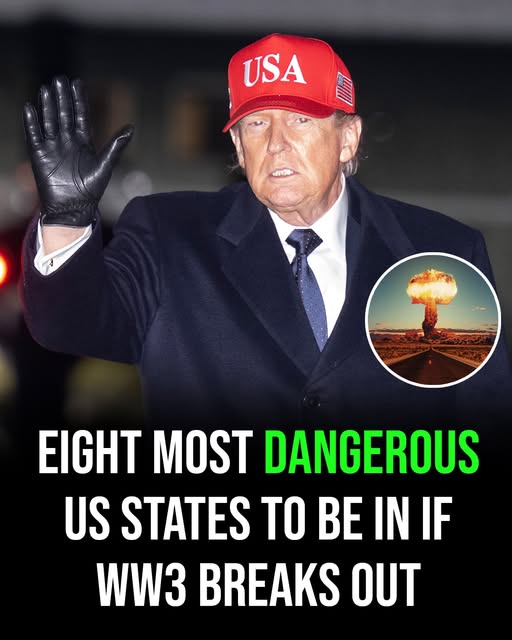
Which U.S. States Could Be Most
The warnings are no longer abstract. World leaders now speak openly about escalation, nuclear weapons, and scenarios once described as “unthinkable.”
As tensions rise, many ordinary Americans are asking a deeply unsettling question:
if a global war begins, is there anywhere truly safe to live?
Security analysts say the idea of a completely safe location is largely a myth.
In a large-scale conflict, especially one involving nuclear weapons, the impact could extend far beyond the initial targets and affect nearly every region in some way.
Still, experts explain that risk would not be distributed evenly.
Areas close to intercontinental ballistic missile fields, major naval bases,
command centers, and large industrial hubs would likely draw the greatest strategic attention during a major conflict.
Military planners have long identified certain parts of the United States as higher-priority targets.
Regions with critical defense infrastructure or dense urban populations could face greater risk in the early stages of a large-scale war.
By contrast, analysts suggest that some parts of the Northeast, Southeast, and
certain interior states located farther from primary military installations might face a lower initial risk in certain scenarios.
However, distance from strategic targets would not guarantee safety.
Modern warfare includes long-range missiles, cyberattacks, and strikes against power grids, communications networks, and transportation systems.
Even communities far from potential blast zones could experience severe consequences, including supply shortages,
disruptions to healthcare systems, economic instability, and large population movements as people seek safer conditions.